How to Create a Strong Password and Protect Your Business
Small Changes, Big Security Benefits. Weak passwords are still one of the biggest cybersecurity risks for businesses.
Westway IT News
When selling a business, most owners focus on financials, customer base, and profitability. While these elements are crucial, buyers increasingly evaluate something far less talked about; operational maturity.
Operational maturity describes how well‑run, stable, and predictable your business is. It reflects how effectively your organisation functions and how dependent it is on the owner’s personal involvement.
And here’s the part many owners underestimate:
Your operational maturity level can significantly increase or reduce your business valuation.
Let’s break down what this means, why it matters, and how it shapes a buyer’s perception of value and risk.
Operational maturity is the extent to which your business has:
A mature business doesn’t rely on one or two key people to keep everything running. It has strong systems, predictable workflows, and clearly defined roles.
Think of it as the difference between:
Buyers always prefer the second.
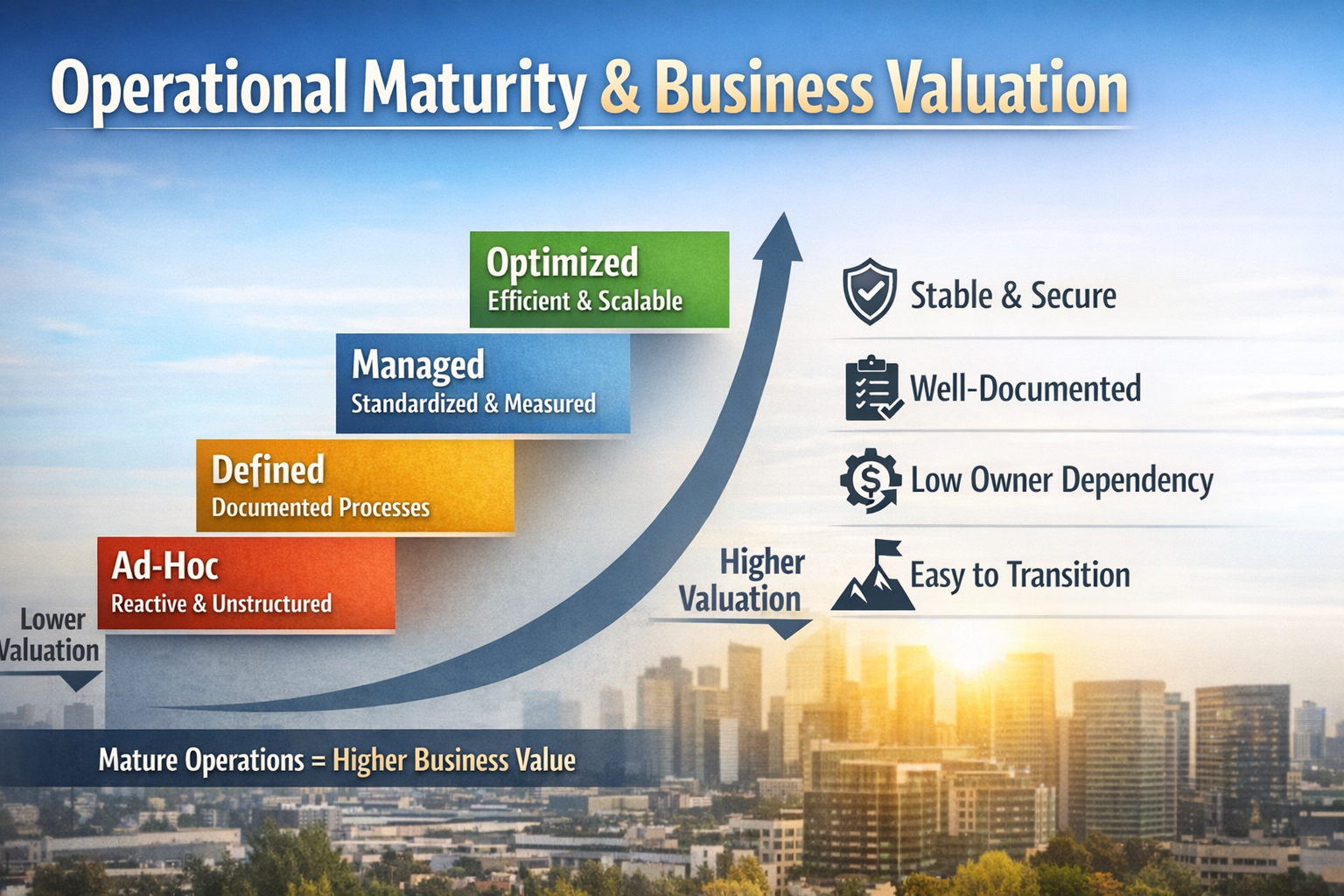
While there are many frameworks, most maturity models follow a similar structure:
To a buyer, this signals risk, meaning a lower valuation.
This is where many small businesses sit. It’s stable enough, but buyers may factor in the cost of upgrades.
Buyers see these businesses as reliable and predictable increasing valuation.
These businesses are highly attractive, often commanding premium valuations.
When buyers assess your business, they’re analysing much more than revenue. They’re asking:
Businesses with high operational maturity score better in all these areas and therefore carry less risk.
Less risk = higher valuation.
Technology is one of the clearest indicators of operational maturity. During due diligence, buyers look for:
A well‑run IT estate signals that the business overall is well run.
A messy IT estate signals risk, cost, and instability.
In many sales, the state of IT alone has shifted valuations up or down by meaningful amounts.
The business relies heavily on the owner; systems are outdated; processes live “in someone’s head”.
Buyer reaction:
They add the cost of upgrading systems, documenting processes, and reducing dependency on individuals.
Result: Lower valuation.
The business has documented workflows, modern IT systems, a trained team, and strong reporting.
Buyer reaction:
They see a stable, low‑risk business with predictable performance.
Result: Higher valuation, faster sale, and fewer renegotiations.
When a buyer sees a mature operation, they gain confidence that:
Confidence increases perceived value.
Uncertainty decreases it.
Even small improvements can meaningfully increase valuation. Start by:
These steps make your business more attractive, more stable, and more valuable.
Operational maturity is one of the most overlooked factors in business valuation, but also one of the most important.
Buyers pay more for businesses that are:
Improving your operational maturity signals to buyers that your business is strong, stable, and low‑risk; and that is exactly what increases valuation.

Managing Director, Westway IT
John is the founder of Westway IT and works directly with small businesses across Gloucestershire to keep their IT secure, productive and stress-free.
With a BSc in Computer Science and hands-on experience supporting businesses from 1 to 40 users, he specialises in cyber security, Microsoft 365 and business automation.
An award-winning MSP owner and active member of the global IT community (including GTIA), John focuses on solving real business problems, not just technical ones.
Published: 23 March 2026 | Last Updated: 23 March 2026